
Ham radio is a bit like fishing, says Maryhill enthusiast Tim Vegh.
To demonstrate his analogy, the retired high school technology teacher recalled the time he made his “biggest catch” after connecting with another operator 10,000 km away.
“So, the guy I’m talking to is in Japan, so I hooked a big one,” he said.
“Did I know that fish were there? I had a good idea. But I did I know that particular fish was there? No.”
And, much like angling, amateur, or ham, radio operators do not always have total control over where they can cast their metaphorical lines, with signals depending on a range of factors, including geography, light and the weather.
Another of those variables is the condition of something called the ionosphere, which surrounds the Earth between 50 and 1,000 km above sea level, and causes radio waves to bounce off it.
“We are only able to pick up frequencies that don’t go right up through our atmosphere,” Vegh said.
“So, most radio frequencies, everything that’s coming off of that antenna, go in a straight line and will keep going off to Mars or wherever it goes.”
But the ionosphere enables waves to travel around this planet instead, he explained.
“Because the sun’s particles and especially other rays hit the ionosphere and ionize it, it becomes able to reflect radio transmission,” Vegh continued.
“So, at some frequency, instead of going up and through it, it bounces down, then it hits the Earth, bounces up to the ionosphere and goes down again.
“It might bounce two or three times before it gets to Japan.”
Vegh, whose call sign is VA3TMV, says his hobby of eight years is in many ways a sport.
He takes part in contests, where the aim is to reach obscure transmitters, such as those on tiny Pacific atolls.
“There’s no money involved, but there’s bragging rights,” explained the member of the Kitchener-Waterloo Amateur Radio Club (KWARC), who uses his teaching skills to train novices to get their operator licences and has a 15-metre and another 10-metre antenna in his three-quarter-acre backyard that are capable of relaying signals around the world.
When he reaches a faraway operator, conversations with the person at the other end can range from any topic as long as it’s not business, as the amateur element is strictly enforced by regulators.
“We shouldn’t talk about politics either and nobody wants to talk about religion, so it’s really mundane things like, ‘Hey, how are you doing? What are some of your hobbies?’ Benign kinds of conversations really.
“But, when you hook the big one, your heart’s beating, palpitating, you’re going, ‘Wow, I did it!’”
Vegh said the feeling is addictive.
Since retiring from a school in Brantford in 2016, having taught for 13 years following an earlier career in tech manufacturing, he has spent around $5,000 on radio equipment.
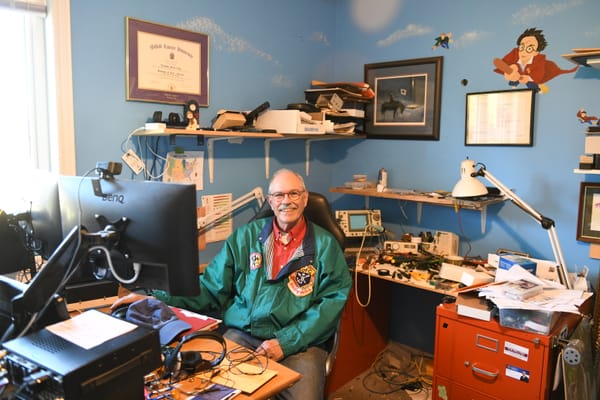
Much of it is inside what used to be the former bedroom of his now 32-year-old son, who is also a ham radio fan.
With Harry Potter motifs still painted on blue walls, the space is perhaps only slightly less magical and curious than the wizarding book and movie series.
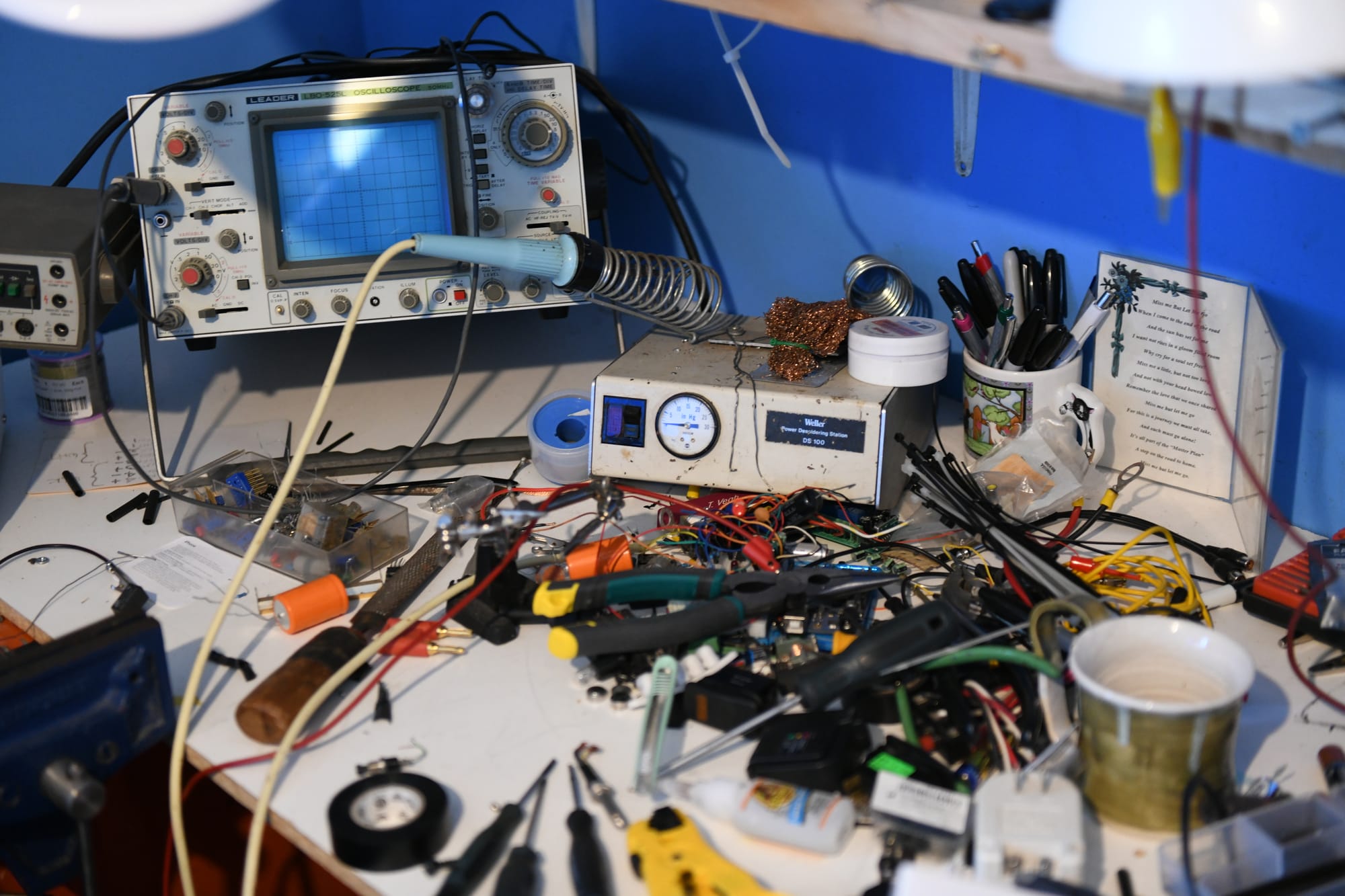
The 72-year-old father of two, who has been married to his wife Frances for 35 years, has several monitors, gadgets, wires and tools in there.
As he uses the high-frequency transceiver, it makes the kind of eerie sonar-type warbling sound one might hear on the bridge of a naval vessel.
Vegh stresses that ham radio, which has been around for around 100 years and got its nickname from what was an initial slur against amateurs, is very different from citizens band, or CB radio, which is a short-distance form of communication often used by truck drivers.
“CB radio is a specific band. It’s close to our 10-metre band and it does not require a licence,” he explained.
“It is limited to five watts power input and is channelized, meaning you have channel one, channel two. Channel nine is the emergency call.
“There are some 40-odd channels. That’s it. You’re limited. We are not so limited. We have a number of different bands, different frequencies, and they’re not channelized.”
Vegh, who made crystal radios as a boy growing up in Windsor and was always fascinated by technology and figuring out how things work, said there are also potentially emergency uses for ham radio if phone, online, email or other communication services failed.
As a result of this possible use, he said around a quarter of those he has taught to use the system could be described as preppers, people preparing for an end-of-the-world scenario.
However, he said most of Canada’s 75,000 licensed operators are more typically technology enthusiasts like him – and this community of like-minded people is something Vegh very much values.
Additionally, he likes helping people learn the skills.
The teaching he does is included along with Canadian licensing tests for anyone who pays $25 for annual membership of his club.
“After I’d taken the course with KWARC, I realized that I could help too. I’m a teacher. I could help teach this stuff,” he said, noting that the courses take place in March each year.
“I also love the community service aspect,” added Vegh, who also volunteers with the Knights of Columbus and is an active parishioner at St. Boniface Catholic Church in Maryhill.
On top of this, he has also enjoyed learning new things.
“I didn’t think I’d be a contester, but I’m doing that. Many people thought they would just talk on the radio, but they are learning Morse code. So, I’m a Morse code contester too, so you really get into it,” he said.
For more information, email timvegh@gmail.com.