
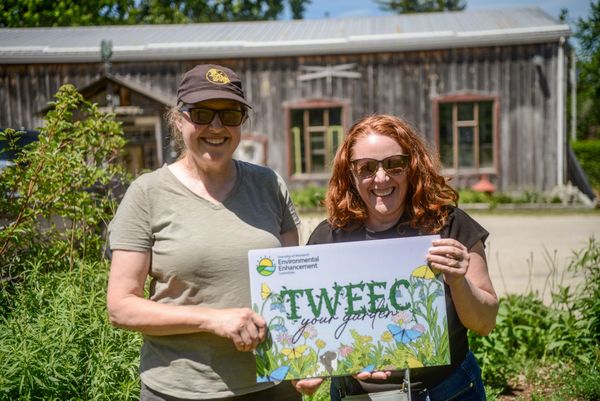
Just south of the Waterloo Central Railway station in St. Jacobs sits Schaner Park, a pleasant place to sit on a bench and unwind. However, in its current overgrown state, it blends into the background. That’s why members of the Township of Woolwich Environmental Enhancement Committee (TWEEC) are looking to revitalize the space.
The group has a vision for the park beyond grass and trees, and plan to transform it with vibrant native plant pollinator gardens and a labyrinth.
To help with the revitalization, TWEEC will receive partial funding from the Region of Waterloo’s Community Environmental Fund.
“It’s intended to support community members who are looking to demonstrate really positive and lasting environmental change projects that are based on citizen engagement and collaboration. We also look for projects that have innovative solutions or contribute to our knowledge of environmental stewardship, testing out new approaches and then what we also look for is things that will have a measurable and achievable outcome,” said Meaghan Eastwood, manager of planning and sustainability at the Region of Waterloo.
Since 2011, the region has granted nearly $2 million to these small local organizations and municipalities through the fund for similar projects.
On June 1, the region announced that 19 organizations, including TWEEC, would receive a combined $90,000 in funding. Of that, TWEEC will receive $6,500 for its project in St. Jacobs.
“This one was really nice to see, because they demonstrated all the many co-benefits of the work, so they noted the fact that they’re immediately adjacent to a school, so this is a learning site, it’s public access, it supports both climate change objectives by providing cooling for the community, carbon storage, and sequestration, but it also helps really provide a sense of place for the neighbourhood at certain anchor space as well. So, this was really easy to support,” said Eastwood.
Schaner Park is just a few steps from St. Jacobs Public School and is near two retirement homes and a daycare. While many people go to Riverside Meadow Park to enjoy green space, those who have to cross King Street North might be deterred by the busy roadway. Revitalizing Schaner Park will make it easier for nearby residents to access outdoor spaces.
“King Street has become very busy, and so some folks have a challenge getting across or going that far, and this way it’s almost in their backyard if they don’t have their own backyard, and that can be very complementary to that, so that’s our vision,” said DJ Hannah, one of the TWEEC members and a butterfly ranger working on the Schaner Park revitalization project.
This isn’t the first time TWEEC has been involved with beautifying Schaner Park. Some of TWEEC’s early initiatives included planting trees and building pollinator flowerbeds to establish a local habitat.
“This park was started 20 years ago. TWEEC got involved, and it was a barren wasteland of railway land. The ground was just clay and cinders, but we planted all native stuff at that time, so white pines and nine barks and chokecherry,” said Janet Cox, another TWEEC member working on the project and a landscape designer at John’s Nursery.
Currently, Schaner has many trees but little undergrowth.
“We had sort of a pollinator garden up by the parking area, but over time people had snuck things in that were native just because nobody was really taking care of it,” said Cox, adding that they would like to see the space look more like a garden when people come to the entrance.
Cox’s experience in landscape design has been helpful to the project. She has already made a blueprint for the project to help people visualize the makeover.
“I’m really excited to do designs that are based on native species and based on reestablishing ecological function, and DJ is the perfect partner, because she’s been very involved in pollinator gardens,” said Cox.
Part of the goal of beautifying the gardens is to create a space featuring native plants where people can draw inspiration for their own gardens.
“We want to make a model where people can say, ‘ Oh, I could picture that in my house,’ and then they can go and get asters and butterfly milkweed,” said Cox.
“There are so many everyday opportunities to build diversity and support native plants and animals, landscapes, and gardens that can look beautiful, but they can also function for all the other creatures that used to live in an area or still are in existence.”
The other portion of the revitalization will be the contemplative labyrinth, to be located in the current grassy patch.
“The idea is that it’s a moving meditation, so in a labyrinth it’s not like a maze, you don’t get lost in it, you just follow one foot in front of another in a narrow path that sort of winds to a centre spot where you can centre yourself and then wind your way back out, following the path,” said Cox.
The labyrinth will feature a stone path in a circular design, and as you walk along the path, you focus on your breathing, reflect, and let go of your worries.
Hannah added that beyond the aesthetic value of the revitalization project, there is an important mental health benefit for the community, hoping the beautification of the park will encourage more people to enjoy the space.
“There are lots of studies about the impact of gardening and being outside, touching grass, touching soil, in terms of mental health. Adding the labyrinth gives it that extra oomph of a draw for people to actually come out and do it. As a display garden, I think it has an awesome opportunity with the number of people that visit St. Jacobs through the train, right, as they go to Elmira, or coming to the school,” said Hannah.
Currently, TWEEC is seeking community partners to secure funding for the labyrinth portion of the project, as the region’s grant will cover the pollinator gardens.