Environmental activism is not for the faint of heart. It requires tireless hours spent staying up to date with laws and science while often going unrecognized for your efforts. That’s why the Watershed Guardian Award takes time to celebrate people making extraordinary efforts towards water conservation in Ontario.
This year, two local advocates from the Waterloo Region were honoured for their work protecting watershed security, spanning toxic chemicals, land use planning, farmland preservation, and the Great Lakes.
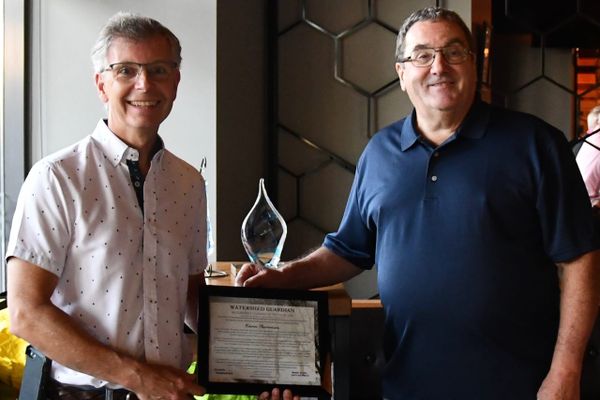
The ceremony took place on July 8 and was hosted by Our Living Waters. The recipients were John Jackson, who received the Lifetime Achievement Award, and Kevin Thomason, named Watershed Guardian of the Year.
Thomason serves as the vice-chair for the Grand River Environment Network and has been involved in the community for decades on topics such as protecting local farmland, managing urban sprawl, and securing regional water systems.
“This is a huge honour from the Ontario Headwaters Institute,” Thomason said.
“It is just fantastic to see them in many ways, yes, recognizing me, but what they’re really recognizing is the work of our entire community. And it doesn’t matter whether it’s the water crisis, the protection of the Waterloo moraine or the farmland protection. … There’s just been so many things that so many people in our community have been involved in recently that all impact water and our water quality.”
Thomason added that he was happy to see Jackson receive the Lifetime Achievement Award for all his work.
“John is just one of these incredible warriors who’s been at this since the ‘60s. His focus isn’t just our region, but how does our region fit within the larger Great Lakes community.”
For Thomason, his journey into environmentalism started 30 years ago when he got the opportunity to stay in the community after moving to the area from Toronto to attend university.
“I thought, ‘Wow, I can live out in the countryside and still wear a shirt and tie to work every day,” he recalled.
After settling in, he noticed the rare and endangered animals around him and wondered why the wetlands and creeks lacked protection.
“Why are they bulldozing that wetland? What’s going on with that creek? This isn’t going to exist if we continue to do this. Somebody’s got to speak up for all these creatures, and somebody’s got to protect this water, our aquifers, and our entire watershed.”
His passion led him to help secure the Laurel Creek Headwaters Environmentally Sensitive Landscape (ESL) designation in 2006, protecting a connected system of natural habitats, aquifers and landforms.
Today, Thomason focuses heavily on pushing for sustainable, smart urban planning. He is a spokesperson for the Wilmot Civil Action Network and recently co-authored a comprehensive, 135-page report detailing how recent land assembly in Wilmot Township bypasses provincial planning rules, lacks transparency and threatens the Waterloo moraine’s water security.
For John Jackson, the journey to becoming an environmentalist started with his childhood love for nature.
“My sort of prime childhood memories are from going out [where] there was a marsh on the farm and going out into the meadow on the farm and seeing the fireflies,” said Jackson.
When he went to University in Windsor, he got involved in his first environmental issue, the partial fuel core meltdown of a nuclear reactor 30 miles south of Detroit in Monroe County, Michigan.
“One of the nuclear power plants called Fermi 1 had actually had a near meltdown. It had started going through the process. Somehow, they managed to get it stopped, but it has never been brought into use again. It’s been completely out of use but it’s still this monster sitting there,” said Jackson.
One of his acts of activism was launching balloons with a group of environmentalists from the nuclear power plant with little postcards attached.
“We want to see where they would go, and with a note on them saying, ‘If you get this card going through the air, you would have, if the nuclear power plant had blown up, received radiation from it.’”
The results stunned Jackson and his fellow advocates.
“You could see a path very quickly. It was amazing. It was a predictable path because the winds tend to blow to the east across the lower part of Ontario, across Toronto, Quebec, but the ones that shocked us most are a few that came back from Scotland.”
Stopping nuclear expansion remains a priority for Jackson. He has also spent decades helping local citizens organize and fight back against hazardous dump sites and waste disposal facility contamination. He is a core figure in the Grand River Environmental Network and a board member of the Canadian Environmental Law Association (CELA).
Currently, Jackson is pushing to add more toxic “chemicals of concern,” like flame retardants, to the national Pollutant Release Inventory to stop them from entering the Great Lakes.
“I’m on the government’s advisory committee with some other environmental groups and some Indigenous people as well as industry,” Jackson said.
“When they’re looking at issues of, should we add such and such? They will ask us for input, including asking industry for input. We don’t always win, but it’s a good mechanism for us to be making some influence.”
Reflecting on his life’s work, Jackson shared his gratitude for the award.
“I love what I do. I have zero regrets about having basically devoted my life to doing these sorts of things. I love it, but it also means the world when some people come forward saying, ‘Hey, we really appreciate what you’ve done with your life.’ The award was really good for lifting my spirits.”