
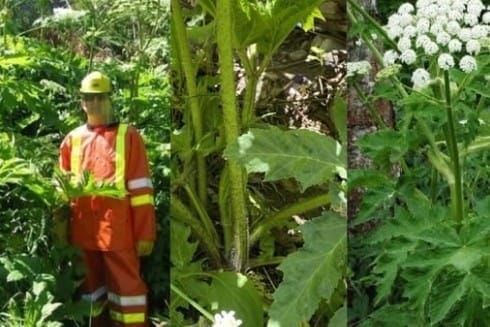
With its towering, vibrant green stems and umbrella-shaped clusters of tiny white flowers, giant hogweed looks straight out of the pages of a fantasy tale. However, despite its unusual allure, it is a plant you do not want to get too close to.
Recently, the Township of Woolwich was alerted to the plant’s presence in Breslau, in the open space behind Dolman Street in Riverland subdivision. Over the past few weeks, municipal crews have been working diligently to safely eradicate the hazard.
“Township staff completed an initial treatment of giant hogweed on township-owned lands approximately two weeks ago,” said Rae Ann Bauman, executive officer of the Township of Woolwich, adding that an additional treatment was scheduled for last week.
“Typically, treatment involves the use of a registered pesticide or horticultural vinegar.”
The removal of giant hogweed is a matter of high priority due to the severe safety concerns it poses to the public. Merely brushing against the plant can result in debilitating injuries.
“Its clear sap contains chemicals that make skin highly sensitive to sunlight. Contact with the sap followed by exposure to sunlight can cause painful burns, blistering and long-lasting skin sensitivity. If the sap comes into contact with the eyes, it can cause serious injury, including temporary or permanent vision loss,” explained Bauman.
Fortunately, the plant is easily identifiable, largely due to its monstrous proportions. Proper identification is vital, as giant hogweed is frequently mistaken for less harmful native species, such as cow parsnip or purplestem angelica.
“Giant hogweed is a very large plant that can grow up to five metres (16 feet) tall. It has large, deeply lobed leaves and, when mature, produces large, white, umbrella-shaped flower clusters that can reach up to 1.5 metres across,” said Bauman.
“Its thick, hollow stems have coarse white hairs and distinctive reddish-purple blotches. Giant hogweed can sometimes be mistaken for native plants such as cow parsnip, so proper identification is important.”
Originally, giant hogweed was from the Caucasus Mountain region between Europe and Asia. In the early 1900s, it was introduced to North America as an ornamental garden plant. However, it escaped cultivation and has since become established in parts of Ontario, including Waterloo Region.
In Woolwich, giant hogweed is most commonly found in moist, low-lying areas.
“Particularly along rivers, streams, drainage corridors and trails adjacent to watercourses.
Anyone who encounters a suspected giant hogweed plant while hiking or using a trail should avoid touching the plant and should not attempt to remove it themselves,” noted Bauman.
Because of the plant’s hazardous nature, the public should leave eradication to professionals. While private property owners are legally responsible for controlling giant hogweed on their land under Ontario’s Weed Control Act, both the provincial government and the Ontario Invasive Plant Council strongly recommend hiring a licensed exterminator.
Professional removal typically requires wearing heavy-duty personal protective equipment (PPE) to block the sap. Exterminators will generally dig out the plant entirely or apply a targeted herbicide application.
Early detection is a major factor in the spread of giant hogweed. Removing the plant before it develops deep taproots (thick, dominant central roots that grow vertically deep into the soil) or produces massive seed banks.
In early spring, plants are typically smaller (less than 30 cm in height), making them easier to dig up. Mature plants develop massive taproots that make manual removal extremely difficult and labour-intensive.
Removing summering plants is trickier. The flower heads have to be removed before the seeds mature and turn green, then bagged separately to prevent the seeds from spreading.
“Giant hogweed can spread quickly if left unmanaged, so early identification and reporting are important in helping reduce its spread and protect public health. Residents are encouraged to avoid handling suspicious plants and to report potential sightings to the appropriate property owner or weed inspection service rather than attempting removal themselves,” said Bauman.
Reports of giant hogweed in Woolwich can be directed to the Region of Waterloo’s Weed Inspection Program, which administers the Weed Control Act on behalf of the rural townships of Woolwich, Wellesley, Wilmot and North Dumfries. Regional area weed inspectors can be reached at 519-575-4400.