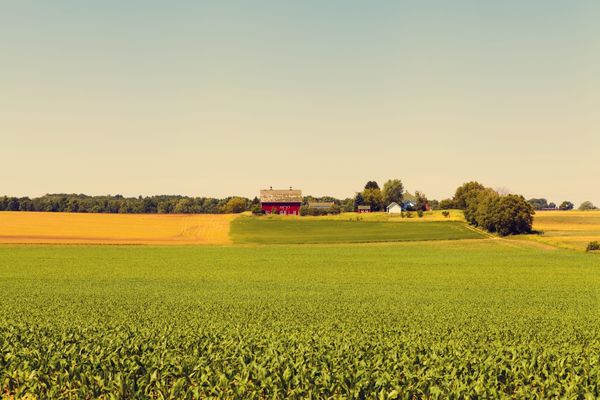
For more than two and a half years, Wilmot farmers have lived with uncertainty about what the future of farmland in the township will look like. The Region of Waterloo continues its controversial campaign to assemble 770 acres of prime agricultural land for use as an industrial site, though news of an end user remains elusive.
While regional authorities surpassed the 500-acre mark this year through various acquisitions, they remain short of their ultimate 770-acre target. The methods used to secure this farmland have drawn intense public scrutiny. Many have criticized the region for relying heavily on undisclosed consulting firms, strict non-disclosure agreements, and the looming threat of expropriation.
The escalating situation brought together Mike Schreiner, leader of the Ontario Green Party, and Kevin Thomason of the Grand River Environmental Network. Meeting on July 7, the two sat down with Wilmot resident John Jordan to discuss the urgent need to protect agricultural land.
“I met with farmers and landowners in Wilmot, some of whom are directly affected by the threat of expropriation, who were just really upset, and I think rightfully so – it was 770 acres of some of the best farmland in all of Canada, expropriated for some industrial mega site that nobody knows any details about,” said Schreiner.
Thomason added that one of the most puzzling pieces of the Wilmot land grab is the massive scale of the proposed project.
“It is an eight-and-a-half-kilometre drive just around the perimeter of this mega-industrial site, and we have no idea what it is because two and a half years into it, there’s yet still to be a single public meeting, a single page of research, a single financial study, any justification, any rationale – nothing whatsoever released on this,” said Thomason.
He added that many questions remain unanswered, such as what it is, who’s behind it, why we need it and what it will do for the community.
The initial rollout of the land assembly was a battle between Wilmot farmers and the government rather than a collaborative public-private planning process, with farmers describing a sudden high-pressure situation.
“All we know is that a huge amount of farmland is going to be destroyed,”
“And farmers who…just literally had men in blue suits show up at their doors telling them they had 10 days to give up their farmland or it would be taken away from them and expropriated. No one should have the government coming to take their farms, their business, their homes, their livelihoods away from them on 10 days’ notice. [They] have lived with this, and other landowners too have lived with this hanging over their heads, for two and a half years.”
The mental and emotional toll of a prolonged legal and political standoff with regional authorities was too much for many farmers.
“Some of the elderly ones said, ‘Look, I’m 82 years old, and I don’t have long left. I’m not going to spend my final years fighting the government.’ And they folded their tent early. Others fought for longer, but then eventually gave up and caved in,” said Thomason.
For farmers who have not given up their land and who surround the proposed sprawling industrial site, the uncertainty has made decisions about their farms carry more weight.
“We’re all in the dark, especially the landowners. I think at a time when there’s just so much uncertainty in the world to put even more uncertainty on the backs of these farmers,” said Schreiner.
“I talked to one dairy farmer who didn’t know what to do. He said, “I want to invest in my dairy operation, but I don’t know if I should be making these investments or not because if I do it, and the land’s taken away from me, then I lose that investment.’”
Both Schreiner and Thomason advocate strongly for protecting farmland. The Wilmot land grab represents a systemic trend across the province, with Ontario losing 319 acres of farmland every day.
“That’s the equivalent of losing nine family farms a week in a province where only five per cent of our land is suitable for growing food, and less than 1.5 per cent is prime farmland,” said Schreiner, adding that once you lose the prime farmland, it’s gone forever.
Thomason added that Ontario’s lack of food security goes hand in hand with the loss of farmland.
“Ontario is not self-sufficient in food. Canada is not self-sufficient in food, and we have to import food just to fill our tables in grocery stores. And if we can continue to lose farmland at the rate that we are, it will only make that situation worse,” said Thomason.
Ultimately, advocates argue that the Wilmot land assembly points to a fundamental breakdown in democratic governance and government accountability.
“With no documentation, no planning, the government is trying to have a complete lack of transparency while telling us they’re the best, most transparent government ever,” said Thomason.
“It’s unfortunate because it’s ruined lives. There have been farmers and landowners die in the last year or two, and the last few years of their lives were miserable. Wondering every single night when they went to bed, is tomorrow the day the government comes to take everything away from me?”