While there is no doubt that pesticides severely impact the health of honey bees, the number-one threat to these creatures is actually a tiny parasite known as Varroa destructor. These mites are just as deadly as their name suggests and are the leading cause of death for overwintering colonies in Canada.
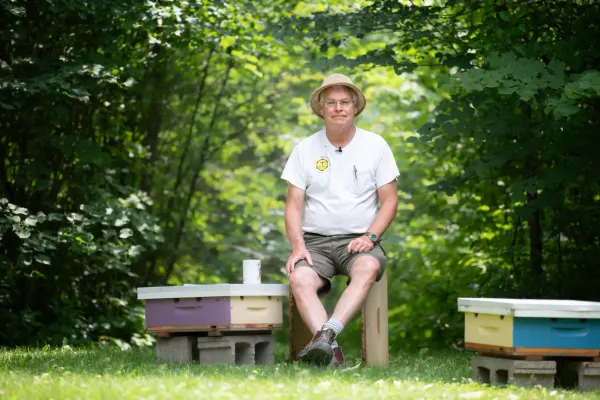
“It’s given that name for good reason,” said Paul Kelly, the research and apiary manager at Honey Bee Research Centre (HBRC) at the University of Guelph.
“They feed on both immature bees and mature bees, and they do so by poking a hole in the bee, and then they feed on their blood and their protein reserves. That hole allows viruses to get into the bee, and the salivary secretions of the mite shut down the bee’s immune system, so the viruses that get in can proliferate so that the virus that they transmit is just as damaging as the mite itself.”
The mites can shorten a honey bee’s life expectancy by 50 per cent or more. They originally came to Canada in the late 1980s, mingling with the Asian honey bee after beekeepers brought European honey bees to Asia. Honey bees in Asia evolved alongside the parasite and developed resistance to it, whereas European honey bees had never been exposed to the mites before.
“It’s to the point now where in North America virtually every hive has the mites in it. In the hive, it’s a matter of whether they’re at a damaging level or not. But they are everywhere. The only exception in Canada is Newfoundland, because it’s an island. They’ve been able to isolate the island, and they don’t allow any importations of bees there, and so the mite still hasn’t got to Newfoundland, but it’s everywhere else in Canada and the U.S.,” said Kelly.
“If a colony is severely damaged by the mites, they leave their hive, they, it’s called absconding, they just take off and they’ll move into another hive, and that’s how they spread the mites from hive to hive, and then from region to region, but with people picking up beehives and moving them from place to place, they also get spread that way.”
Every year, the might has a devastating impact on honey bee colonies in Canada. That’s why the University of Guelph’s HBCR developed the Low Varroa Growth (LVG) breeding system, allowing beekeepers to track which colonies have resistance to the mites.
“What we’ve found is that the most important factor is the ability of the bees to groom the mites off their body. So, take the mite off their body, and then they actually chew on them afterwards, that’s what we’re looking for,” said Kelly.
‘It’s very difficult to test for this grooming behaviour, labour-intensive, and we can do it on a research level, but it’s difficult for beekeepers to do.”
The LVG makes this process simpler. Instead of testing for grooming behaviours, the program gets beekeepers to measure the mites in a colony.
“We measure the number of mites in a colony in the spring, and then 16 weeks later we measure the number of mites in the colony for the second time, and the difference between those two is the growth rate of the mites,” explained Kelly.
Beekeepers can then raise queens from colonies with the lowest growth rates of mites.
“By selecting this, we’re selecting for this grooming behaviour, but also any other behaviour the bee might have that would contribute to resistance, and it’s just a simple thing for beekeepers to measure.”
Kelly noted that this method has now become one of the more effective controls for mites. Dating back to the 1990s, the mite problem was first tackled with chemical control. However, finding products that killed mites without harming honey bees was difficult. Another issue was mites developing resistance to chemicals after prolonged use.
“The mites develop a resistance to them over time, and so that’s one of the big issues, is that we have products that work for a while and then they don’t work,” said Kelly.
He added that his team has found working with naturally occurring products, such as essential plant oils and organic acids, shows some effectiveness in the fight against Varroa destructor.
“If we use the same materials over and over again, especially if there’s synthetic chemicals, those chemicals target one metabolic pathway in the mite, so if it’s only targeting one metabolic pathway, all they need is one mutation to get resistance, and then those might survive and breed,” said Kelly.
Naturally occurring chemicals, by contrast, act in a more complex way, involving multiple metabolic pathways, which makes it more difficult for mites to develop resistance to them. Kelly listed plant oils such as thyme, oregano, and clove, as well as organic acids such as formic and oxalic acid, as being researched for use as a miticide.
Kelly added that spring weather plays a big role in the severity of Varroa infestations.
“Back in 2021, we had an extremely warm spring, and over the following winter, we lost a lot of hives, roughly 50 per vent of the hives in Ontario perished. This year it looks like the levels of losses will be lower. It’s too early to give you any numbers on that. We really don’t have them yet, but just speaking with other beekeepers, it seems like most beekeepers had at least an okay success rate through the winter,” said Kelly.
The LVG breeding project is knowledge that the HBRC team shares with beekeepers at conferences across North America. Considering the importance of honey bees to Ontario’s food system and biodiversity, Kelly is passionate about sharing this knowledge. Bees pollinate around one-third of crops for food in Canada. Honey bees from managed colonies account for 80 per cent of that pollination.
“So, honey bees are extremely important for human food production, and all the native bees, all these over 400 species of bees that are here in Ontario are really important for pollinating specific native flowers and trees, so we need all these bees for both nature and, in the case of honeybees, for agriculture.”