Many homeowners might have an unexpected neighbour in their chimney.
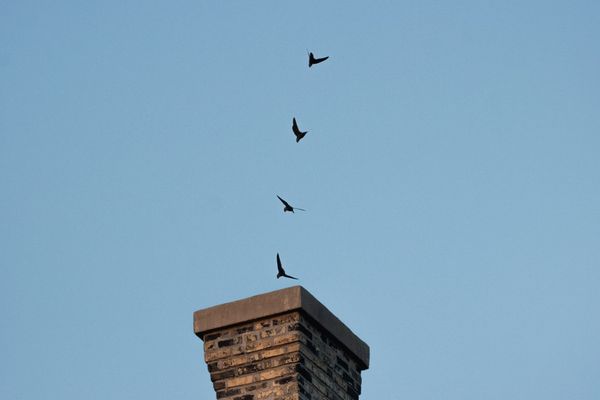
Chimney swifts, as their name suggests, have adapted to make their nests in old chimneys. Their population has declined 90 per cent since 1970, placing them at significant risk of being listed as endangered.
To help keep track of swift populations, Birds Canada has a citizen science project called SwiftWatch, which BirdFriendly Kitchener is a partner of.
“It’s a national program, which means anyone can take part in it. You don’t have to be a specialist; you don’t have to be an ornithologist or a birder. As long as you can identify chimney swift, then Birds Canada is happy to have your help,” said Jennifer Clary-Lemon, co-chair of Bird Friendly Kitchener.
“There are a number of chimneys in downtown Kitchener that Birds Canada does not have enough data on to know whether or not their current nesting sites are roosting sites, and so we started a local initiative where volunteers can sign up for specific chimneys to watch to see whether or not they’re inhabited by swifts.”
Part of the decline in the swift population is attributed to the modernization of buildings, with chimneys now capped, and/or steel-lined and old chimneys torn down.
“They don’t land. Their feet are too short to perch, so they nest, they roost, and they sleep at night in chimneys, because they can cling to the rough innards of the old chimneys,” said Clary-Lemon.
“New chimneys have liners, and so they aren’t inhabitable by swift, so that’s another reason why it’s important to kind of conserve the habitat that they do have, which happens to be old chimneys.”
Clary-Lemon added that the chimneys the swifts prefer are typically the larger industrial ones found in downtowns. The Swift Watch is important because it helps organizations such as Birds Canada identify which chimney sites need protection.
Anyone across Canada can volunteer for SwiftWatch, which involves spending about an hour in the evening watching for swifts on May 28 and June 1. Volunteers can opt to volunteer for as many or as few days as they would like.
“It’s actually probably the most fun of any bird watching activity, because you don’t have to get up early in the morning,” said Clary-Lemon.
“It’s in the evening, 30 minutes before the sunset, so you can bring a lawn chair and a friend, and then you keep your eyes on a chimney for an hour and see what happens, and then about 30 minutes after sunset, that’s when your swift-watching duty is over. You record what you see and submit it to Nature Counts.”
Clary-Lemon added that sometimes the birds are confused with bats. However, if participants see what they think are bats entering a chimney 30 minutes after sunset, it is likely a chimney swift.
“They’re a bird that people don’t see very often, because they spend not only their entire days in flight, but they fly higher than other birds. They fly above the tree line, so you know they’re up at the fifteenth story when we’re looking at birdsup in a little tree, so they were historically very mysterious. Humans didn’t really know what they were, because they never got a glimpse of them because they were so high up, and so people would think it’s evening, things are flapping around, they’re going into a building, so there’s this kind of assumption that they could be a bat, but they are not. They are birds,” said Clary-Lemon.
Volunteers can select any chimney they think might be suitable as their location to stake out for the SwiftWatch. However, there are certain sites that Bird Friendly Kitchener recommends. They receive a list of recommended chimney sites from Birds Canada, based on data from previous years.
“But I’ve seen swift flying around, for example, downtown Waterloo, and Waterloo has no known chimneys that are on Birds Canada radar. I’ve seen swallows flying around the Princess Cinema. I have looked for where they’re going. I have no idea where-it’s a mystery, which is kind of fun to figure out where some of these swifts are going at night,” said Clary-Lemon.
“So. if a chimney looks suitable, and by suitable I mean, again, more industrial, they usually are about at least three feet by three feet wide, so generally not residential chimneys. Those are kind of the chimneys that you would look for, but if the swifts are around, they have to be going somewhere, and it’s always just trying to figure out where that somewhere is.”
For more information, interested participants can visit www.birdscanada.org/bird-science/swiftwatch.