
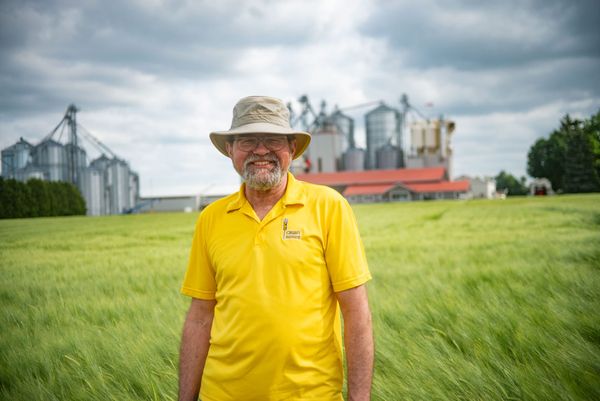
A local, family-owned seed producer and retailer is part of the cutting edge of Canada’s agriculture research in crop production. Cribit Seeds, located in West Montrose, partners with top genetic suppliers such as SeCan and DEKALB to test, grow, condition, and produce seed varieties.
“In order to have Canadian sovereignty, I would argue that we need Canada’s food security, and in order to achieve that, we need to be investing in Canadian agriculture, and by that, I mean research and product development, of course and in the case of crop production, it is variety development,” Cribit Seeds co-owner Quentin Martin told The Observer.
A large portion of Cribit’s operation is research trials. They conduct rigorous field testing and maintain hundreds of replicated test plots, where they screen varieties and hybrids to determine which are high-yielding and best suited to the southwestern Ontario climate.
“Because Ontario’s so huge, and the growing season is very different across the province. That’s why it gets broken up into different regions, and you want to kind of test in all those regions to decide where your variety might work if you’re developing,” said Martin.
The research acts as a critical bridge between public crop researchers and local commercial farms. While crop researchers develop the genetics, they do not always have the ability to commercialize them. Cribit Seeds takes the new genetic lines and hosts research partnerships and screening plots to test the newly crossed experimental lines. They partner with organizations such as SeCan, DEKLAB, the University of Guelph, and Agriculture and Agri-Food Canada.
“We’re just looking at the material that SeCan sends and says, ‘Here, look at these.’ We grow them out, we harvest, and we compare the yields,” said Martin.
“Because farmers primarily care about yield. That’s the commodity, the value of the quantity. Then there are all these other details,” he said adding that disease resistance is also taken into account.
One of their ongoing projects is the winter barley program, which focuses on establishing winter barley as a viable alternative to winter wheat for farmers in Ontario. Winter crops are those planted in the autumn, go dormant during the winter, and are harvested in the spring.
While winter barley has historically done poorly in Ontario, Cribit Seeds, in partnership with SeCan, public plant breeders, and the Grain Farmers of Ontario, is looking to see the crop make a comeback by importing and testing advanced, cold-tolerant genetics from Europe. Currently, there is no winter barley plant breeder in Canada.
“Through SeCan’s efforts, our efforts essentially reignited winter barley as an option in Ontario in the last five years. It’s been the last two years, really, that it’s starting to pick up,” said Martin.
The development of new winter barley varieties could be a significant benefit to growers, as winter barley offers higher yields and rotation options compared to wheat. Winter barley has also been shown to help reduce field erosion and topsoil losses due to winter and spring runoff.
Since the crop matures earlier than winter wheat, it will more effectively spread out the workload associated with seeding and harvest for farm operations.
Martin expects half of the Ontario barley crop will be winter barley by 2030.