As flowerbeds are coming to life, so are the bees. While you may have observed them flying around your garden, there is an even better way to see the bees in action this summer.
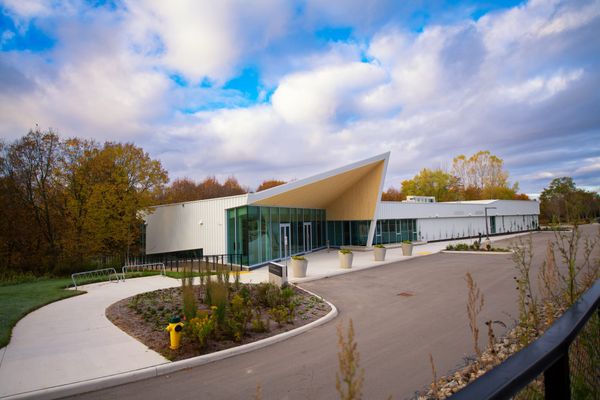
The University of Guelph is inviting the public to explore its brand-new, hive-inspired Honey Bee Research Centre (HBCR) on Stone Road at an open house on June 26 (2-7 p.m.) and June 27 (2-5 p.m.). The new facilities provide a massive upgrade to the previously cramped 1960s bungalow the HBCR operated out of.
“For roughly 60 years, we haven’t had appropriate space. Years ago, there was a building on campus that was just an awesome building. It was the best bee centre in North America, and it was right in the centre of campus, but it was torn down in the early 70s to make way for the university centre when the colleges came together and formed a university, and so we lost a really good building there. We haven’t really had appropriate teaching space since then. We’ve been able to carry on with the research and teaching at the university level, but not at an appropriate space for the kinds of courses and tours and things that we do,” said Paul Kelly, who has managed the Honey Bee Research Centre since 1987.
The new 15,000-square-foot facility will serve as a hub for pollinator research and apiculture. Previously, researchers were working out of a converted small bedroom. Now they have a fully equipped lab with a safety shower, eyewash station, fume hood, microscopes and computers – everything they need to research the bees.
Beyond research, the HBCR serves as an important education center for university students and the public, offering tours in the spring, summer and fall to anyone from preschool groups to seniors.
Kelly said the HBCR team is happy to get the message out about the importance of honeybees to everyone in the community.
“Honey production, for sure, is something important for beekeepers, but for everybody, pollination is the most important aspect of honeybees. A third of the food we eat benefits from bee pollination – 80 per cent of that is done by honeybees,” said Kelly.
The open house will show participants how the HBCR functions as a farm, research centre, education centre and retail operation. Researchers manage 200 to 300 honey bee colonies for research, teaching, and demonstration at the HBCR.
“We’re for the most part showcasing our new centre and touring people through the facilities. It’s on a drop-in basis, so guests can just wander around the building, and we’ll have personnel stationed throughout to describe activities that we do here at the research centre. We have bee yards outside, so there’ll be somebody stationed outside to explain what we’re doing with the hives, and inside we have a research lab where people can see what kind of work we’re doing research wise.”
For Kelly, the new centre brings excitement and relief. It’s something that has been in the works for a decade.
“Ten years, one hundred challenges at a time – that’s maybe the exaggeration, but it’s been an enormous project. And it’s a $17 million project,” said Kelly.
“The majority of the money for the building was raised through fundraising, so we’ve done pretty well in ten years to be able to accomplish our goals here, but a project this big has a lot of challenges. We’ve designed four different buildings on three different locations, and we’ve worked through Covid with the fundraising.”
Kelly and the other researchers are looking forward to moving beyond the challenges and enjoying the capabilities of the new facility, which were also made fully accessible.
Anyone interested in visiting the new HBCR open house can visit 460 Stone Rd. E. on the last weekend in June.