
Asparagus is the first local crop that makes it onto spring menus, signalling the start of Ontario’s local food season.
Asparagus has a narrow seasonal window lasting about six to eights weeks, from early May to late June. This year, it’s been a rocky start to the season for producers.
Hot weather in April combined with overnight frosts in mid-May caused significant losses across Ontario’s fields. Asparagus thrives in sunny locations and the best growth for the plant occurs between 18 and 30 degrees Celsius.
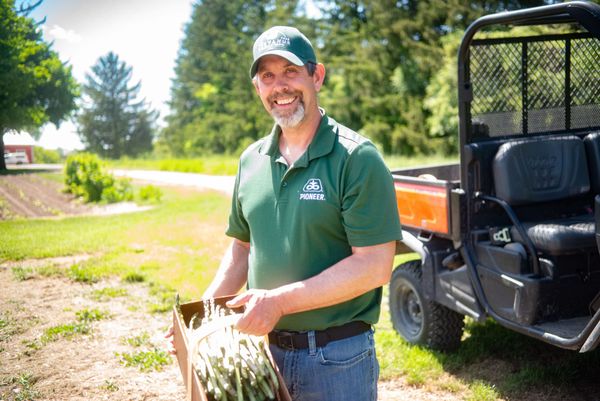
Aaron Stevanus, the owner of Stevanus Farms in Bloomingdale, has felt the growing pains this season.
“Lately, the cooler night temperatures that we’ve been having, under 10 degrees Celsius, it’s just kind of slowed it (asparagus growth) off,” he explained.
For spears to push through the soil and grow, they need heat. Typically, spears begin to emerge when soil temperatures reach 10 degrees.
“Also in the spring, when we had all those colder temperatures, we were almost two weeks behind when we normally would start picking,” said Stevanus.
Another factor contributing to this year’s short supply was last year’s dry, hot summer. Asparagus is a perennial crop, which means that the previous year’s weather impacts the plant. The energy for the next spring’s harvest relies on the leafy “ferns” that grow the previous summer.
“A lot of the times the previous year dictates what you get the next year. With asparagus, it’s a big root crown that’s about eight inches in the ground, and so when we stop harvesting, we let it grow up, and it turns into about a six-foot tall fern, and so what that does is taking all the nutrients down into the root and prepare it for the next year. We also fertilize it, too, to make sure that it pushes production, but the drought last year, with a lack of moisture – we don’t irrigate – we feel has an effect on our yield, as well. So, it (asparagus crop) hasn’t been producing as much as we like, and unfortunately, we have to be closed here and there because of what the weather brings,” said Stevanus.
His storefront has been closed more often than usual this year, with demand for the tasty green spears outpacing the available supply.
“We’re always trying to provide as much as we can to our customers. We always feel bad when we have to be closed because it doesn’t help with consistency, and we feel bad that we can’t offer that. Just because it’s in the grocery store doesn’t mean it’s available locally,” said Stevanus.
“It could be coming from Norfolk or Harrow, which is still Ontario, which is good, but sometimes it ends up also being from Mexico. So, if you want local asparagus, sometimes you have to be patient with the farmer and work with what Mother Nature gives them, and know that we always want to provide as much as we can to our local region as much as possible.”
Currently, Stevanus has a third of an acre of asparagus. When it’s ready to be harvested, he handpicks it himself, sometimes with the help of his son. While there is a rough timeline for how long asparagus season will last, the harvest is really at the whims of the weather.
“As weird as it sounds, the asparagus tells you when it’s ready, or it just doesn’t have as much push. They start to fern out earlier, so we just kind of go by what the field’s telling us that it needs to start to fern out and put reserves down for next year, but usually it’s around Father’s Day, it’s over,” said Stevanus.
Ferning out is when the asparagus spears open up and develop into tall, feathery, bush-like foliage. When spring harvest is over, allowing the remaining spears to fern out is an important step for farmers to help maintain the root crowns (essentially the asparagus’ root system) over the winter.
With the high local demand for asparagus this year, Stevanus has decided to expand his own production. Next year he is adding a new patch, doubling his capacity for farming asparagus. However, it will be a few years before the new crop is actually ready to harvest.
“It takes about four to five years to get full production after planting, but we’re excited to be expanding and putting a new patch in next year,” said Stevanus.
Once it’s established, Stevanus explained that asparagus is a pretty easy plant to grow. The rules are you fertilize it and you cut it once or twice a day depending on how hot the temperature is.
“The challenge is what we ran into last year, not having irrigation available, the last summer being a droughty summer, just didn’t get those nutrients down to the rootstock to provide for next year. And then the hot and cold temperatures in the spring, we can’t do anything about that. So, from a management standpoint of what we can do, it’s pretty easy, but then you’re very much reliant, as everything in farming, on what Mother Nature brings you,” said Stevanus.
Beyond asparagus, Stevanus also grows sweet corn, potatoes and a little bit of everything else, green beans, kale, peas, beets, carrots, tomatoes and jalapenos.
As a farmer he is happy to see a growing demand for local food.
“I think that’s a fantastic thing, because it just kind of keeps our whole economy and community going.”