
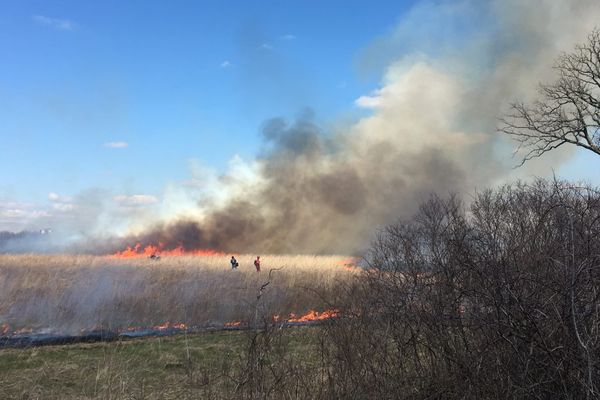
What might look like destruction at first is a carefully planned reset for ecosystems like prairies in Ontario. Prescribed burns improve prairie health, reduce wildfire risk and restore habitat.
In Woolwich, the Elmira Nature Reserve is home to one of the only tallgrass prairies in the area. The Rare Charitable Research Reserve in Cambridge is also home to a 20-hectare restored tallgrass prairie ecosystem known as the Blair Flats restoration project, which runs along the Grand River.
A prescribed burn is planned for Blair Flats next year.
“We’ve got our third burn plan for our 40-acre site next year,” said Andrew MacDougall, a professor of ecology at the University of Guelph.
“You can safely burn a large area in five minutes, and the heat – it’s just insane. And when we burn them down in Blair Flats, we have to call the [region’s] airport to warn them, because the smoke plumes, the heat creates these little tornadoes of smoke that go about 4,000 to 5,000 feet up in the air.”
Tallgrass prairies are the wettest in North America, which means trees can overgrow the prairie, choke the ecosystem and kill it. Historically, grasslands have evolved to burn frequently, sparked by seasonal lightning or intentionally ignited by Indigenous communities. Fire removes dead vegetation and prevents woody trees from taking over.
“That’s the biggest risk, actually, with the remnant conservation areas, the remnant prairie habitats. If you don’t burn them, they’ll be infilled with trees, and a lot of them haven’t been burned since the 1800s. So tree infilling is a big issue.”
MacDougall added that while many people argue that trees taking over is the natural order of things, when prairies were more extensive in Ontario, fire was actually nature’s way.
“Fires occurred all the time, and so they would maintain this system forever, actually. But fires have been removed, in the Smokey the Bear phenomenon, “where only you can prevent forest fires.”
While that campaign was great for preventing the destruction of forests and human habitats, an unexpected outcome was that when fires did strike ecosystems like forests, they were more intense.
Without previous smaller burns, forests accumulate unnaturally high fuel loads, which is dead wood, thick underbrush, and ladder fuels.
“Where it applies more than tallgrass prairie is western North American forests, where there’s been catastrophic fires over the past couple of decades, especially recently. It’s a huge issue there,” noted MacDougall, adding that while climate change usually takes the blame for worsening forest fires, big fuel loads have a major role to play.
“Seventy-five years to 100 years of intense fire suppression has built up these massive fuel loads. If you don’t burn the fuel loads, fuel loads get to a level where the fires are way, way hotter than they would be otherwise, if you burn semi-regularly.”
In grasslands, fuel load build-up can also be an issue.
“If you don’t burn them on a regular basis, the fuel, the plant litter, builds up, and if someone flicks a cigarette out of the car window, you can get a really much, much bigger burn than what we see when we do it on purpose,” said MacDougall.
“This is the conservation challenge. The irony of Smokey Bear: it’s meant to do good things, and it does, but it just creates a longer-term problem because the fuel loads build up.”